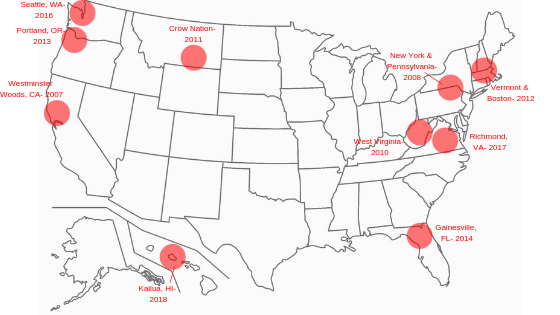
Applications are now available for our June 2-9, 2012 Eco-Stewards Program in Vermont and Boston. Spread the word! This program for young adults (age 20-30) will focus on Climate Change & Christian Activism in light of the recent surge in protest movements from Occupy Wall Street to Tar Sands Action to 350.org. Join us as we meet with Occupy Boston’s spiritual leaders, visit Walden Pond to discuss Henry David Thoreau’s Civil Disobedience, help with Hurricane Irene relief projects in Vermont, talk with 350.org’s grassroots organizers and discuss our individual eco-faith journeys while hiking in the Green Mountains or paddling the Connecticut River. You can download the application here. Rolling admissions close March 1. Questions? Send an email to revrobmark@gmail.com
Apply Now for the Eco-Stewards Vermont & Boston Program
January 20, 2012Eco-Stewards Vermont/Boston Program Set for June 2012
December 21, 2011
We are excited to announce plans for the upcoming Eco-Stewards Vermont/Boston Program to be held June 2-9, 2012. The program will focus on Climate Change & Christian Activism in light of the recent surge in protest movements from Occupy Wall Street to Tar Sands Action to 350.org. Join us as we meet with Occupy Boston’s spiritual leaders, visit Walden Pond to discuss Henry David Thoreau’s Civil Disobedience, help with Hurricane Irene relief projects in Vermont, meet with 350.org’s grassroots organizers and hike in the Green Mountains or paddle the Connecticut River. Applications for the week-long program and paid summer internships will be posted soon. In the meantime, email revrobmark@gmail.com with any questions.
Eco-Stewards Program Featured in Presbyterians Today Magazine
December 18, 2011
The December 2011 issue of Presbyterians Today features The Eco-Stewards Program in an article exploring how young adults are encountering God through programs focused on caring for God’s creation. You can read Anitra Kitts’ “Learning from the land” article by following this link. Both Brian Frick and Rob Mark are quoted in the article, and you’ll also find some familiar photos snapped by our Eco-Stewards reporters.
Some Thoughts on Mindful Living
December 5, 2011
Montana Eco-Steward Vickie Machado is a graduate student in the Religion and Nature master’s program at the University of Florida. She lives at The Gainesville Catholic Worker House, where she recently gave a talk on mindful living.
After helping out here for about two and half years, I committed to living at The Gainesville Catholic Worker for the Fall semester. This Catholic Worker House is one of more than 150 Catholic Worker communities around the world dedicated to living the social dimension of the Gospel by serving and living with the impoverished, struggling for social and economic justice, and working for peace. We practice this through our weekly activities, which include Dorothy’s Café, Breakfast Brigade and Art for All.
We strive to live as an intentional, faith-based community committed to a life of prayer, scripture study and culture critique. As a house, we host a variety of events that act as an effort to carry out these ideals. In terms of culture critique, we hold a monthly Roundtable Discussion. The first Thursday of every month, the house hosts a potluck dinner in which everyone is invited in the hopes of promoting dialogue on topics and issues pertinent to the world we live in today.
In October, I co-led a roundtable discussion on mindful living with Dr. Whitney Sanford, a professor at the University of Florida. We hosted a good group of about 24 people over a potluck family-style dinner. Dr. Sanford discussed the intentional non-violent, Gandhian-based communities (the Possibility Alliance and Dancing Rabbit) that she had visited this past summer. And I focused my part of the discussion on my time spent last summer with the Eco-Stewards in Montana. Together we showed how living an intentionally-based life is possible and how the way it is carried out varies from place to place. We really stressed the importance of being aware of the impact humans have on the world and the other people around them.
The following is a reflection I wrote after thinking more about this roundtable discussion on mindful living:
Socially, environmentally, and spiritually, we have the opportunity, more so the personal responsibility, to account for our actions. This accountability works best with love. In order for an effective and lasting change, we cannot blame others for not being able to make the common sacrifices we take for granted. We must support one another. Even a small change is better than no change at all. As much as I dream about writing those “angry letters,” I have learned you catch more flies with honey rather than vinegar. We are ALL God’s children. Sometimes we need a friendly word to ease ourselves into things. Trust me, three years ago I would have never thought I would be living at a Catholic Worker House, but after being here for a couple months, it seems so natural.
As cliché as this sounds knowledge is power. It’s not that people don’t care, sometimes they just don’t KNOW. In those cases, we must open up the conversation, not with guilt and condemnation, but with hope and love- and with humility.
For those that do know, I believe it was Peter Maurin who said we must create a society in which it is easier for people to be good. We must promote positive changes in our communities and in our social structures that allow us to care for the environment, the people around us, and the world at large. We were put here on this earth for a reason: to love God and to love our neighbors. These aspects go hand in hand, and I think most people would agree this is not something that stops at a church, a synagogue, a mosque, a temple, or any other place of worship/spiritual growth.
I truly believe love is something that must be carried out into the world. What better way to show love than through the everyday mundane things we usually take for granted? So with this, I encourage you to live your life with intentionality. However it is carried out. Don’t walk around with your head in a cloud, strive to know the impact you have in and on this world. Create community; bike somewhere; build an Earthship; know where the food you eat comes from; engage in discussions. Most of all: love people. We only have one life, and it goes by fast.
Please consider The Eco-Stewards Program in your year-end charitable giving. Donation information is listed in the sidebar on the right.
Building A Reflective Community
October 17, 2011
Eco-Steward Kathi Pogorelov studies public health and sociology, with a concentration in health and environment, at The College of New Jersey. She took a break from her coursework to reflect on her participation in the June 2011 Montana Eco-Stewards Program.
Eco-stewardship means more than caring for the environment; it means caring for “our” environment, possessive, as in an entity which belongs to and is very much an extension of our being. It involves a type of caring which does not view oneself as separate from the surroundings in which one exists, but rather, as a permeable part belonging to a larger whole. One of the inside jokes among the Montana Eco-Stewards, in fact, was the concept of “fractals”– the humor was in repeating the word ‘fractals’ over and over with a certain emphasis that evoked feelings of infinite complexity and sci-fi awe.
A fractal “is a rough or fragmented geometric shape that can be split into parts, each of which is (at least approximately) a reduced-size copy of the whole,” according to Wikipedia. From this structural perspective, all sorts of environments, depending on scale, can be seen as reflections of one another. Whether it be on a biological, psychological, familial, societal, ecological, global or other kind of organizational level, the health of one environment affects and mirrors the health of all other environments. None are exclusive to this phenomenon. Therefore, when our ecosystem is in any way out of balance, as earthlings, so are we. With this holistic understanding comes the responsibility and role of the Eco-Steward, demanding conscious choice, from what we purchase and put into our bodies, to how we live our lives.
It is this awareness of collective ownership upon which we formed a culture of eco-stewardship. As our mission in Montana strengthened thanks to a shared ideology (and love of farm food!), we unexpectedly began to form our very own ‘social ecosphere’. Similar to the community of the Crow Reservation, we too created a ‘tribal family’ during our time spent together. Congregating into circles, storytelling, gathering over hearty meals, car drive conversations and other bonding events were among the many activities that revealed the group’s great synergy. In effect, a ‘safe place’ between Eco-Stewards had been birthed into existence. By fostering a nourishing environment of acceptance, openness, mutual care and support, we had effectively planted the seeds for a tribe of gardeners. Our united knowledge and interactive collaboration had grown into something beyond ourselves, nurturing and empowering us in ways that could not have been accomplished alone. Each one of us, with our natural light, had burned a hole into an otherwise ordinary slab of wood, etching a piece of art that only Crow portrait artist Jon Beartusk could challenge.
Big Sky in My Heart
September 27, 2011
Eco-Steward Gerard Miller is living in Los Angeles after spending his summer at Greenwood Farm in Hardin, Montana. As part of the Episcopal Urban Intern Program, Gerard works as a campus aide at the Alliance Health Services Academy High School, a public charter school in South LA. Here he reflects about his time on Greenwood Farm and the Crow Reservation.
There is so much that happened during my two months at Greenwood Farm that it’s impossible to distill the experience to the “best” or “choicest” moments. Though the work was hard, building an Earthship and doing other farm tasks were as much a part of my personal and spiritual growth as the rest of it. Being able to get down and work with my hands, to learn by doing, and to be deeply in touch with the “stuff” of the Earth really fulfilled a longing that I had. I now have a deeper personal understanding of the parables and the lives of the prophets and patriarchs of the Bible, and of my personal calling.
Here’s a sample of my typical day at Greenwood Farm:
Our wake up call at 6 a.m. rolled around all too quickly, and that powerhouse of Dave Graber, like time and tide, waits for no man. Not willing to let a man 40-some years older than us show us up, Dave Grace (my fellow intern) and I struggled out of those soft beds and headed down to work.
Once outside in the early morning light and cool air, things were better. I fell into a good rhythm and felt like it was no time before Bonnie called us in for breakfast at 7 a.m. Before we ate, we would read daily Psalms from the missal handed out by the Catholic church in Crow Agency. Then, one of us would pray over the food and the day. Mealtimes were one time during which I felt the most different from everyone else. Raised by a southern or southern-oriented family, I was taught to take my time and enjoy the food and fellowship as much as possible. More often than not, at breakfast, lunch and dinner, the Daves and Bonnie would be up clearing the table and washing dishes while I was finishing the last third of my plate.
Then it was time for the real work, which usually went from about 7:45 a.m. to about noon. Weeding the garden, mowing the considerable grounds, rebuilding the chicken coop, planting trees, and working on that monster of an Earthship, I worked like I have never before. Relieved when at 11:45 a.m. I went in to help Bonnie set up for lunch, around 2:30 p.m., we were handed over to “Graber” again. We’d continue working until 5 p.m. or 6 p.m., depending on the task at hand and what else was going on.
“Grace” withstood my daily rant, where I used things we saw or heard on the radio as a way to think through and organize my thoughts after so much study over the past several years. I can never be more grateful for him putting up with me as I preached to him, the choir.
Many table-side conversations were opportunities to learn from the life and wisdom of the Grabers, who have lived exceptional lives and stand as examples of a well-thought and well-applied faith. I also gleaned a great deal from talking to the Mark’s (Dave and Bonnie’s daughter, Kristen, and her husband, Dave), who had their own insights into both temporal and spiritual matters. We agreed on so many things that it surprised me, and those areas in which we saw differently, challenged me to consider my stance. Even the Mark children taught me attitudes, ways of understanding, and a patience that I couldn’t have gotten without their earnest and lively input.
In addition to life at Greenwood Farm, we also got out into the community of rural Montana, particularly the Crow Reservation. We attended numerous cultural events, among them: Catholic and Pentecostal church services, Baptist and Pentecostal camp meetings, pow wows, rodeos, Crow Hymns Ministries meetings, a Sun Dance, and a sweat. These cultural events gave me insight into the daily emotional and spiritual lives of the people in the area. I saw God manifested in so much of the experience– the people, places, and events– that I’m still playing it back to extract understanding. The ideas of community, of koinonia, and of intentionality guided and highlighted my time on the Res. It expanded my worldview and deepened my conviction to discern my gifts and callings, though they be without repentance. I carry Big Sky in my heart.
Rethinking Our Rivers
August 20, 2011
Eco-Steward Josh Campbell graduated in May from Oklahoma Baptist University, where he studied cultural anthropology. He will soon start a master’s program in international agriculture and development at Oklahoma State University. The program will focus on using agriculture to preserve, sustain, and develop communities. Here he reflects on what he learned during our June Eco-Stewards Program in southeastern Montana.
During our time in Montana, the Eco-Stewards explored many subjects related to personal faith and the environment. One of the things we explored together was the connection between the environment and personal health – the idea that the land one lives in can play a major part in one’s physical health. Lack of care for the environment often leads to poor health conditions for the people that live in and depend on the land that is treated poorly. This is the case for those living on the Crow Reservation and other places in Montana.
While in Montana, our group met with Mari Eggers, an ecologist and doctoral student at Montana State University, who has conducted water quality research with students at Little Bighorn College and community member research partners on the Crow Reservation. She and her family have lived on the reservation and know first hand the complexity of environmental issues and how they can affect the health and well being of people.
Eggers discussed how water contamination is impacting public health on the Crow Reservation. The pollution of river systems in Montana is the result of many practices that don’t take consideration for the environment. Some of these include: mercury emissions from power plants; straight pipes, which take sewage from houses straight into the river systems; runoff from chemicals used in farming; animal waste; and inadequate municipal wastewater treatment. There is also concern about mineral contaminants from old uranium mines reaching the rivers, an issue currently being researched by one of Eggers’ colleagues. The level of fecal contamination makes the rivers unsafe for swimming in some locations and at some times during the year. In addition, many people on the Crow Reservation rely on shallow well water for home use; approximately half of these wells have tested positive for bacterial contamination and/or unsafe levels of mineral contaminants such as manganese. Community members are also concerned about pesticides from agriculture in their groundwater, an issue now being researched in the Bighorn River Valley on the Reservation by the U.S. Geological Survey.
Eggers noted that their project has tested mercury levels in local fish, and found that the larger fish of some species are high enough in mercury that women of childbearing age and children should not consume more than one serving of these fish per month. The Environmental Protection Agency (EPA) has also tested fish in the reservoir on the Reservation, and found that the local walleye have some of the highest mercury levels of all the fish they tested nationwide. This seems absolutely wrong to me. Water in many cultures and faith traditions is the most sacred element– the source of life. Life depends on clean water for survival, yet, we take it for granted. What are we doing wrong that it is not safe to eat fish from our waters?
I live in Oklahoma, where natural gas companies are one of the major employers, chemical agriculture is the norm, and Indian reservations are packed into one small place like sardines in a can. It is a place where our river systems are all but gone, yet, I have never really stopped to consider any of these things. In fact, not until my time in Montana, did I stop to think about how the improper treatment of the environment could directly affect people. I have never really considered issues of environmental racism on Indian reservations. Nor the effects of chemicals used in agriculture and natural gas production. Now that I am home, I feel guilty for being blind to the issues around me, but also responsible for sharing with others the importance of our natural world and caring for it properly. If we care for it, it will care for us.
I recently read a 2009 New York Times article showing that an estimated 1 in 10 Americans have been exposed to drinking water that contains dangerous chemicals or fails to meet federal health regulations. Here in Oklahoma we know first hand the horrible effects pollution can have on both human, and non-human environments. The former town of Picher, now a ghost town, was once a city in Ottawa County, Oklahoma and was formerly a center of lead and zinc mining. Discoveries of ground contamination and the possibility of a cave-in of mines under the city forced much of its population to evacuate. The nearby town of Cardin is now experiencing the same issues. As a result of the devastation from mining, Picher’s population plummeted from 1,640 people in the 2000 census to 20 in the 2010 census— it is believed to have no true residents today. This devastated land belongs to the Quapaw Tribe of northeast Oklahoma. After the mining, and after the government moved everyone away, the Tribe was handed back the worst environmental disaster site in the country.
After my time in Montana, I do not have an answer to the complex problems that we and our environments are facing, but I do believe that understanding that there are problems, and being aware and concerned about the issues in the place you find yourself, is very important. When our environment is sick, we are sick. We depend on our environment for life and when the environment we live in is disrespected, human life is also being disrespected. Any environmental problem is a human problem.
Now, may God grant us wisdom to understand and the eyes to see the environmental issues affecting the well being of others, and may we be brave enough to advocate for any part of creation where there is injustice. May we be instruments of God’s justice and peace so that all creation might be in right-relationship.
On Leaving Montana
August 2, 2011
Eco-Stewards Intern Dave Grace stacked hay, repaired a chicken coup and built an Earthship-style garage and goat-milking barn during his stay at Greenwood Farm this summer. He is a sustainable agriculture major at Warren Wilson College.
Tomorrow I will say goodbye to Greenwood Farm and Montana for a while. I have a lot to say about my time here and the thoughts I’ve been having, but I won’t be able to provide much detail in 500 words—so I will just outline the basis for these thoughts and provide a few examples that offer a glimpse into the value I’ve found in joining the Graber family, if only temporarily, in their work and lives.
My Christianity is founded upon resistance to the implications of The Fall while trying to stay attentive to the spirit within me and the signs of the promise of redemption around me. The basis for this is in wild nature—God’s original intention for humanity as expressed in Genesis. For me, this is where the discussion of Christianity and the environment is centered: the fundamental breakdown in human relations and alienation from Earth characterized by The Fall. When it comes down to distilling this theology into practice, it is a matter of creating egalitarian relationships, based in wildness, that are human to human and human to nature. This is an expression of love that is not ideological or fantastic but an experienced reality in alignment with the highest expression of love in God’s grace.
My time at Greenwood Farm has been highly beneficial to me. I see relationships in this family that demonstrate an intention of loving relationship. This intention extends to Greenwood Farm and to involvement in the wider community—from the Crow Hymns Project to the Bighorn Valley Health Center. In short, I really appreciate the genuine respect and care that I felt from this family.
Here at Greenwood Farm, I’ve assisted with many projects: construction of an Earthship-style garage and goat-milking barn, using tires packed with sand, clay and cob for its walls; stacking hay bales and mowing grass; chicken coop repair; leveling an area for a bunkhouse floor; and preparing barrels for hot water storage. This work has proven to be educational for me, especially the Earthship construction. It has offered me an experience of reclaiming an industrial waste (tires) to put to other uses that have the potential to increase self-reliance and community responsibility. I find the necessity of work troubling in civilization, as its production focus is misleading from a wild state of communion in nature. However, there seems to be a way of subverting work’s aims if this necessity is understood and does not become a force of domestication.

Dave Grace (front, red shirt) and Dave Graber (back, red shirt) begin construction on the Earthship structure made from reclaimed tires.
As I leave this internship, I am looking forward to getting in touch with Mi Media Naranja in North Carolina to further study these intimate connections between nature and Christianity. But first, I’m heading to Alaska, where I look forward to fishing for salmon.
Finding Communion in Song
July 22, 2011
Eco-Steward Gerard Miller studied modern languages, linguistics and intercultural communication at the University of Maryland-Baltimore County. He is working this summer as an intern at Greenwood Farm in Hardin, Montana. Here he reflects on a day from our June Eco-Stewards Program.
Looking back on our week of active learning in Eastern Montana, the one thing that comes to mind as a theme, or overarching idea, is the voice. All week, we sat or stood in conversation with one another, sharing our ideas of God and the world and lending our personal insights to each other’s queries and assertions. This was most true on Saturday, our second day at Greenwood Farm in Hardin. We had gone to sleep the night before under a clear, star-strewn sky like nothing I’d ever seen. Gathered around the campfire, we’d lifted our voices in song, submitting our favorites as requests to be sung by the group. The songs we chose told something about each of us, and about what we thought of the group. It was a great time for fellowship, with any lingering nervousness or anxiety covered by the inky blackness that surrounded the dancing flames.
Earlier that day, we had started our morning with prayer and a song, both of which served to unite us and lend a sense of purpose to our work for the day. After breakfast, a group of Eco-Stewards went to offer their hands and strong backs to Dave Graber in setting the foundation for the earthship outbuilding at Greenwood Farm. Others hung around inside the farmhouse for an impromptu jam session around the Grabers’ piano. With guitars, piano, harmonicas, and our humble and wonderful human voices, we continued to weave together a common narrative and to unify our voices.
As a choir director and musician, I really appreciated the spirit of cooperation, of koinonia (the Greek word for Christian fellowship or communion), that came to the fore as we sang. This was helped along later that afternoon, after Heather arrived and led us through the writing and sharing of our “ecofaith journeys.” The idea was to reflect on those influences which had led us to the spiritual and ecological place that we find ourselves in today. Whereas our songs had told something of our personal and corporate stories, these stories and the way one flowed into the next created a fluid, lyrical song. It was a beautiful time of sharing in the true spirit of God’s message to His people and Jesus’ example. Having broken bread, we gave up our voices to a chorus, singing His praise, reflecting on His works, and seeking deeper purpose in our own walks.
Negotiating Difficult Terrain
July 15, 2011
Eco-Stewards Intern Andrew Foltz-Morrison is constructing a community garden this summer at Krislund Camp in Madisonburg, PA. This fall, he will return to Rutgers University, where he is double majoring in philosophy and geography. Here he reflects on a moment from our June Eco-Stewards Program in Montana.
“As you walk back, stay separate from the rest of the group and just take in the landscape on your own.”
We were given these instructions just before climbing a very steep rock face on our way back to the Rim Country Land Institute in Billings, Montana. And so we walked. Each person found his own way up. I chose to climb more than walk, taking large steps from rock to rock as I made my way up the rock face. As I climbed, I could hardly do anything apart from focus on the terrain in perhaps the most direct manner possible. Though I largely found the path on my own, I did look to see where others ahead of me had gone and adjusted my route accordingly. The thought of that stayed with me as the ground leveled out. As a student of geography, I seek to understand the landscapes that surround us, but it is always at a degree of abstraction far greater than the simple task of getting from one point to another on the terrain. I also wish to understand the social dynamics that affect these landscapes; it was refreshing to very directly see and participate in one.

Eco-Stewards hike through mixed grass prairie at the Rim Country Land Institute in Billings, Montana.
I noted afterward that this concept of negotiating difficult terrain was an apt metaphor for the work that we, as Eco-Stewards, have to do in the world. We have to bring people together across both physical and mental landscapes. In order to bring about the change we seek to do, we have to reach people where they are, and show them where they need to go. But we also have to give them the opportunity to find their own way of getting there. The act of negotiation necessitates nothing less, if we are to give people the participation they deserve to have in changing our world for the better. It also implies a sense of mutual understanding that I usually don’t experience with things like physical landscapes. But if we are to discover a more just and sustainable way of living in and caring for God’s creation, we must recognize the reality and importance of things like us. Just as we respect the perspectives of other people in our negotiation, so too must we come to an understanding with the natural world as we negotiate our relationship with it.
Another important thing about negotiating: it never goes exactly as you intend or expect it to. At my internship at Krislund Camp and Conference Center, I am helping to build both a physical garden and the network of people who will support it in years to come. Any part of ministry is slow work, and working with volunteers means accommodating their schedules and plans. Nevertheless, it also means giving them the opportunity to think differently about their relationship with their food. I also must learn to be humble in my interactions with the land itself. The rototiller, when confronted with the rocky Pennsylvania soil, reminded me of this quite nicely! It is also quite late in the planting season, so I must seek to understand what can and cannot grow in the remaining warm months. I’m also figuring out what it means to negotiate with a constrained budget as I scavenge whatever materials I can for raised beds from around camp. I am, however, very grateful for the opportunity to link this type of negotiation with positive action in whatever way I can.
Building A Community Health Center
July 7, 2011
Eco-Steward Dave Grace is a sustainable agriculture major at Warren Wilson College. After participating in the Eco-Stewards Montana Program in June, Dave stayed in Montana to work as a summer intern at Greenwood Farm. Here he reflects on a discussion with board members of the Bighorn Valley Health Center.
HARDIN, Montana– In the spacious workshop at Greenwood Farm, our Eco-Stewards contingent gathered with Hardin community members to discuss the proposed Bighorn Valley Health Center. The workshop, where we ate many of our meals, was cleared to arrange chairs in a circle for the discussion. Dr. David Mark, who is the CEO of the community health center, gave an overview of the proposal and opened the floor up for dialogue with other volunteers who are helping to make the health center a reality.
One obvious distinction with other health providers in the area is that the Bighorn Valley Health Center is a not-for-profit entity that is entirely run by volunteers. This seems to be one of many distinctions. In order to be a Federally Qualified Health Center, which the center is awaiting confirmation on, the board must be made up of local residents who, taken together, reflect the gender and racial ratio of the county. To me, this seems an obvious benefit in terms of capacity to serve the community: How else could the question of health be adequately addressed, except when considered from within the context of the social and physical environment of the community?
Using a preventative approach, Bighorn Valley Health Center seeks to address the effects of long-term health problems at their root by making connections between human behavior and environmental quality. Perhaps most significantly, this care is being directed toward the most vulnerable– statistically identified as those who are 200 percent below the federal poverty level.
Our discussion concluded in prayer, blessing the efforts of those who are committed to opening the doors of the health center to the people of Big Horn County.
According to its website, Bighorn Valley Health Center is “committed to developing a community-based, outpatient health care and multi-service center designed to serve the whole community of Big Horn County. We recognize that though health care begins by alleviating sickness, the journey to a true culture of health is achieved through the health of the whole person and the whole community.” To learn more about the health center, click here.
And follow this link to read Eco-Steward leader Katie Holmes’ reflection about the community garden we visited at St. Andrew Presbyterian Church in Billings.
What I Learned in Big Sky Country
June 30, 2011
Eco-Steward Evelyn Meisenbacher attends Drew University, where she is majoring in environmental studies as an undergraduate student. Evelyn is co-president of the Drew Environmental Action League and a member of Students for Sustainable Food and Food Justice. Next semester, she will reside at Spirituality House, a community of religious students who promote faith-based activities on campus. In the post below, Evelyn reflects on her participation in the recent Eco-Stewards Montana Program: Sustainability and Reconciliation through Agriculture, Health and Green Building.
I distinctly remember the first emotion I had upon my arrival in Billings, Montana—awe. I was overcome by the landscape. As a New Jersey native, I wasn’t used to the breathtaking amount of space I encountered here in the Northwest—stark cliffs overlooking vast, rolling plains, bordered by snow-capped jagged mountains in the distance.
What I would come to learn over the course of a week, however, is that this land—for all its rugged and seemingly well-worn exterior— is not infinite, and it is not invulnerable. The recent floods, after years of drought, have made farmlands susceptible to ruin. The reality of intensive coal mining is looming—which, for all its economic benefits, would wreak massive environmental damage, threatening air and water quality. Unsustainable ranching practices contribute toward the continued overgrazing of the plains, the misuse of public waters, and the permanent loss of biodiversity. The water that runs through the Crow reservation is ridden with mercury and coliforms.
The forces of modernization have swept among a place and people once rich in cultural heritage. We have neglected our care for the earth. But after hearing the stories and testimonies of folks from all different walks of life, I can be sure now, more than ever, that healing and reconciliation are taking place. I think I’ve emerged from this week-long experience with not only that initial sense of amazement at the beauty of Creation—but with an inspired outlook to protect it. Environmental justice is as mandated by the Christian faith as social justice in the traditional sense. If we fail to do our part in taking care of the earth, we have ultimately failed ourselves. But the message at the end of the week was not a misanthropic, doom-and-gloom pessimism—it was a message of hope. By strengthening the ties of community, just as we did in Montana, we can restore what has been lost, and celebrate what we do have.
“The earth is the Lord’s, and every living thing. Let us take care—let us be aware!”
Be Still And Know: An Eco-Steward’s Reflection
June 24, 2011
Eco-Steward Vickie Machado wrote this reflection about a particularly moving day she experienced during our recent Montana Eco-Stewards Program: Reconciliation and Sustainability through Agriculture, Health and Green Building. Machado studies religion and nature in a graduate program at the University of Florida.
GREENWOOD FARM, Montana– After a delicious breakfast of homemade bread and apple butter, we all headed out to the open space behind the farmhouse to engage our bodies, minds, and spirits in some morning yoga. After various positions of dog, cat, cobra, and tree, Rob read Scripture from a Celtic prayer book: “Be still and know that I am God” (Psalm 46:10). This message rang true through our meditation. God was all around us in the far off mountains and the vast blue sky. It placed our minds at peace as we embarked upon the day’s activities.

We rounded up our crew and set off to explore the Crow Agency. Upon arriving in Crow, we drove around town, seeing the college, hospital, and various churches. We drove by a skate park, a great idea until we realized the placement of it was a bit far from the center of town, let alone kids who wanted to utilize it. Our journey led us to Spirit of Life Foursquare Church, a Pentecostal church with a new building. Unsure of what we would be doing, most of us dressed in old work clothes and rain boots so we could help in flood relief. Upon arrival at the church, we offered ourselves to wherever we were needed. Since the skies were blue and there was no standing water, our group was led inside to help prepare the church for a wedding. We vacuumed, mopped, cleaned bathrooms, and washed windows in an effort to help Kenny Pretty On Top Jr., the worship leader who was in charge of the preparation. He showed some of us his soundboard equipment featuring an array of musical technology, which was all pretty impressive.
Toward the end of our cleaning session, a couple of us went with Rob to meet the Backbone family, who lives nearby. They were so kind and inviting. I was surprised with the amount of people at the house. Family and extended family lived together. Coming from a rather small family, I really appreciated this. The joys and dangers of life on the “rez” took a real form as I learned about high school graduation celebrations and tragic car crashes.
We walked back over to the church to find everyone outside ready for a small tour of the area. Kenny walked us around the neighboring lots. He recalled growing up with a father who taught him that “if it ain’t green, it ain’t clean.” He commented on the fact that kids today didn’t view the world like this, and mostly everything is considered expendable in their eyes.
We departed the church and continued our tour of Crow at the hospital. It also was a fairly new building. Being closed due to the flood, we were able to go inside to explore. Elements of Crow culture were found all around the hospital. A couple display boxes held intricate beadwork, while the walls were lined with various paintings depicting native culture, such as one piece of artwork which portrayed the elk tooth dress, a traditional gown worn by respected women. Upstairs we learned about smudging and how it was practiced as a kind of cleansing ritual. We also were shown the inside of an interfaith chapel, a circular meditation room designed to resemble a tepee. There was an altar-like space on the side of the chapel, open and inviting for any religion or tradition. While native medicine was not included in the hospital, we were told it was not uncommon for patients to seek additional medical advice from grandmothers and medicine men. As we left the hospital, I looked to the sky, a few wispy, white clouds floated through a background of blue: “Be still and know that I am God.”
Back at Greenwood Farm, we ate another delicious lunch and were given some down time. A group gathered inside by the piano, making beautiful music; others went outside to start work on the earthship, cutting tires and filling them with sand and dirt. With a shovel in my hand and a broad brimmed hat from China on my head, I joined the work outside. I thoroughly enjoyed the hands-on experience of starting an earthship. While my help was minimal, I still felt the importance of putting my body to work, of being productive, or better yet in the sense of the natural environment, being fruitful. I imagine both groups felt the importance of being useful and creative, be it piecing together a song or putting our efforts together to start the foundation of a low energy structure.
After a shower at the local pool (which was INDOORS, understandable given the winter snow, but still a crazy thought for this Florida girl!), we headed back to the farm for dinner, a presentation, and the start of our eco-faith journeys.
Earlier in the day, back at the Pentecostal church, we had asked Kenny about the intersection of land and faith. He said something that stood out to me: “I don’t associate God with places, I associated Him with people [pointing to his heart].” While I had discovered this throughout my life, I found that this wild Montana landscape seemed to truly hold God’s power. After all, our group had gathered together on this eco-stewardship program in an effort to connect God with the land. After listening to the eco-faith journeys and sharing my own, I realized how applicable Kenny’s statement was to our day and our time spent together. God is not just in the land, but He is in the people around us. Many of us had voiced this as we shared our outlooks on the intersection of social and environmental justice. They go hand in hand, and you cannot consider one without the other.
Looking back, I saw God throughout our week together. Like Joe Bear Cloud had said the previous day, “God gives us the language through sounds: wind, water, and earth [earth being man who was made from dust].” I heard the language of God in the mountains and in the sky. I also heard God in our journeys: in our hardships, confusion, and joys. God is in so much, sometimes it takes a new atmosphere in order to silence the noise of the world and hear His voice. At the end of the day and before our campfire, we gathered outside to stand in awe of the setting sun and the fiery sky. Once again the words appeared: “Be still and know that I am God” and know that I am here.
Stories From Crow: A Multimedia Slideshow
June 17, 2011Our team of Eco-Stewards reporters and photographers created this multimedia slideshow featuring stories of those living with and from the land on the Crow Reservation and in Big Sky Country. The theme of our 2011 Montana program was “reconciliation and sustainability through agriculture, health and green building.” Enjoy this 8-minute video. And in the toolbar on the right, we’ve added recipes from Greenwood Farm and information about how to donate to the Eco-Stewards Program.
Connecting Under the Wild Montana Sky
June 13, 2011In June 2011, the Eco-Stewards shared an amazing week together under the Wild Montana Sky:
This slideshow requires JavaScript.
Posted by ecostewardsprogram